CURL - Object recognition in images using curriculum learning
Project funded by UEFISCDI under grant number PN-III-P1-1.1-PD-2016-0787, according to contract PD15/2018.
Host institution: University of Bucharest
Host institution: University of Bucharest
-
Project Summary
Over the last few years, handcrafted models for object recognition from images have been replaced by trainable models based on deep learning, due to the impressive recognition performance of the latter models. Indeed, convolutional neural networks (CNN) achieve state-of-the-art performance for object recognition, semantic segmentation and related computer vision tasks. Convolutional neural networks are inspired by the hierarchical structure of the human visual cortex, but there are many aspects that are not captured by CNN. One of the most important aspects is that humans usually learn concepts on a progressive basis, starting with the easy concepts first. As we pass through the educational stages in school, we learn more and more advanced concepts that require our previously gained knowledge for proper understanding. All schooling systems across the globe prove that humans learn better using a curriculum. Although CNN models reach very high accuracy levels for object recognition, the examples are usually presented in a random order during training. The main goal of our project is to train state-of-the-art CNN models using a curriculum learning paradigm, in which examples are presented gradually, from the easy ones to most difficult ones. In our recent work published at CVPR 2016 [1], we showed that the difficulty level of an image (with respect to a visual search task) can be automatically predicted (see figure below). More precisely, we proposed a regression model based on CNN features that can assign a difficulty score to an input (test) image, and we also showed that our difficulty predictor generalizes well to new classes (not seen during training). Hence, we can use the predicted difficulty scores to sort a set of images according to their difficulty, and use this information to train new CNN models in a curriculum learning setting. Our aim is to improve both the recognition accuracy and the training time of these state-of-the-art models.
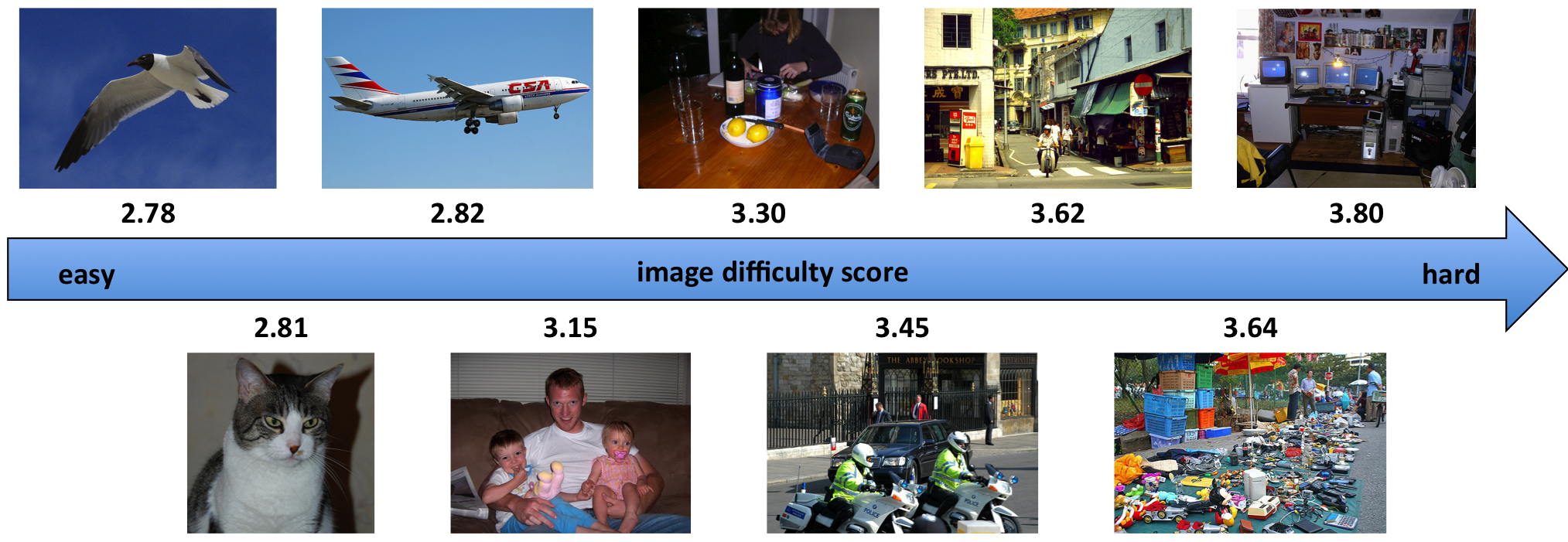
[1] Radu Tudor Ionescu, Bogdan Alexe, Marius Leordeanu, Marius Popescu, Dimitrios Papadopoulos, Vittorio Ferrari. How hard can it be? Estimating the difficulty of visual search in an image. In Proceedings of CVPR, 2016.
-
Papers Funded through the CURL Project
8. Petru Soviany, Claudiu Ardei, Radu Tudor Ionescu, Marius Leordeanu. Image Difficulty Curriculum for Generative Adversarial Networks (CuGAN). In Proceedings of WACV, 2020. (Rank A Conference). [ArXiV]
7. Andrei M. Butnaru, Radu Tudor Ionescu. ShotgunWSD 2.0: An improved algorithm for global word sense disambiguation. IEEE Access, 2019. (Rank A Journal)
6. Radu Tudor Ionescu, Fahad Shahbaz Khan, Mariana-Iuliana Georgescu, Ling Shao. Object-Centric Auto-Encoders and Dummy Anomalies for Abnormal Event Detection in Video. In Proceedings of CVPR, 2019. (Rank A* Conference) [ArXiV]
5. Radu Tudor Ionescu, Sorina Smeureanu, Marius Popescu, Bogdan Alexe. Detecting abnormal events in video using Narrowed Normality Clusters. In Proceedings of WACV, 2019. (Rank A Conference) [ArXiV]
4. Petru Soviany, Radu Tudor Ionescu. Continuous Trade-off Optimization between Fast and Accurate Deep Face Detectors. In Proceedings of ICONIP, 2018. (Rank A Conference) [ArXiV]
3. Petru Soviany, Radu Tudor Ionescu. Frustratingly Easy Trade-off Optimization between Single-Stage and Two-Stage Deep Object Detectors. In Proceedings of CEFRL Workshop of ECCV, 2018. (Rank B Workshop)
2. Petru Soviany, Radu Tudor Ionescu. Optimizing the Trade-off between Single-Stage and Two-Stage Deep Object Detectors using Image Difficulty Prediction. In Proceedings of SYNASC, 2018. (Rank C Conference) [ArXiV]
1. Mădălina Cozma, Andrei M. Butnaru, Radu Tudor Ionescu. Automated essay scoring with string kernels and word embeddings. In Proceedings of ACL, 2018. (Rank A* Conference) [ArXiV]
-
Open Source Code
1. Open Source Code for the paper:
Petru Soviany, Claudiu Ardei, Radu Tudor Ionescu, Marius Leordeanu. Image Difficulty Curriculum for Generative Adversarial Networks (CuGAN). In Proceedings of WACV, 2020. (Rank A Conference). [ArXiV]
-
Project Team Members

Radu Tudor Ionescu - Principal Investigator
Radu Tudor Ionescu is Professor at the University of Bucharest, Romania. He graduated from the Faculty of Mathematics and Computer Science of the University of Bucharest in 2009, and he obtained a Masters of Science diploma in Artificial Intelligence as valedictorian from the same university. He completed his PhD at the University of Bucharest in 2013. He received the 2014 Award for Outstanding Doctoral Research in the field of Computer Science from the Romanian Ad Astra Association. Radu is teaching Computer Science and Artificial Intelligence lectures at the University of Bucharest. His research interests include machine learning, computer vision, image processing, text mining and computational biology. He published over 60 articles at international peer-reviewed conferences and journals, and a research monograph with Springer. Radu Tudor Ionescu received the "Caianiello Best Young Paper Award" at ICIAP 2013 for the paper entitled "Kernels for Visual Words Histograms". In 2017, Radu received the "Young Researchers in Science and Engineering" Prize organized by prof. Rada Mihalcea for young Romanian researchers in all scientific fields. He was also awarded the "Danubius Young Scientist Award 2018 for Romania" by the Austrian Federal Ministry of Education, Science and Research and by the Institute for the Danube Region and Central Europe. Together with other co-authors, he participated at several international competitions. They have ranked on 4th place in the Facial Expression Recognition Challenge of the WREPL Workshop of ICML 2013, 3rd place in the Native Language Identification Shared Task of the BEA-8 Workshop of NAACL 2013, 2nd place in the Arabic Dialect Identification Shared Task of the VarDial Workshop of COLING 2016, and 1st place in the Arabic Dialect Identification Shared Task of the VarDial Workshop of EACL 2017.
Marius Leordeanu - Mentor
Marius Leordeanu is Associate Professor (Senior Lecturer) at the University "Politehnica" of Bucharest and Senior Researcher at the Institute of Mathematics of the Romanian Academy. He is interested in the nature of intelligence, life and consciousness. In particular, his research focuses on computer vision, machine learning and robotics. At the university, he teaches the graduate level computer vision and robotics classes. Marius received his Ph.D. in Robotics from Carnegie Mellon University in 2009, and Bachelor degrees in Mathematics and Computer Science from the City University of New York, 2003. His research made contributions to learning and optimization for graph matching and probabilistic graphical models, object recognition and tracking, 3D modeling of urban scenes, boundary detection, optical flow, activity recognition, feature selection, object discovery and classification in video.
-
Reports
1. Activity report for 2018 (Romanian version).
2. Activity report for 2019 (Romanian version).
3. Activity report for 2020 (Romanian version).